
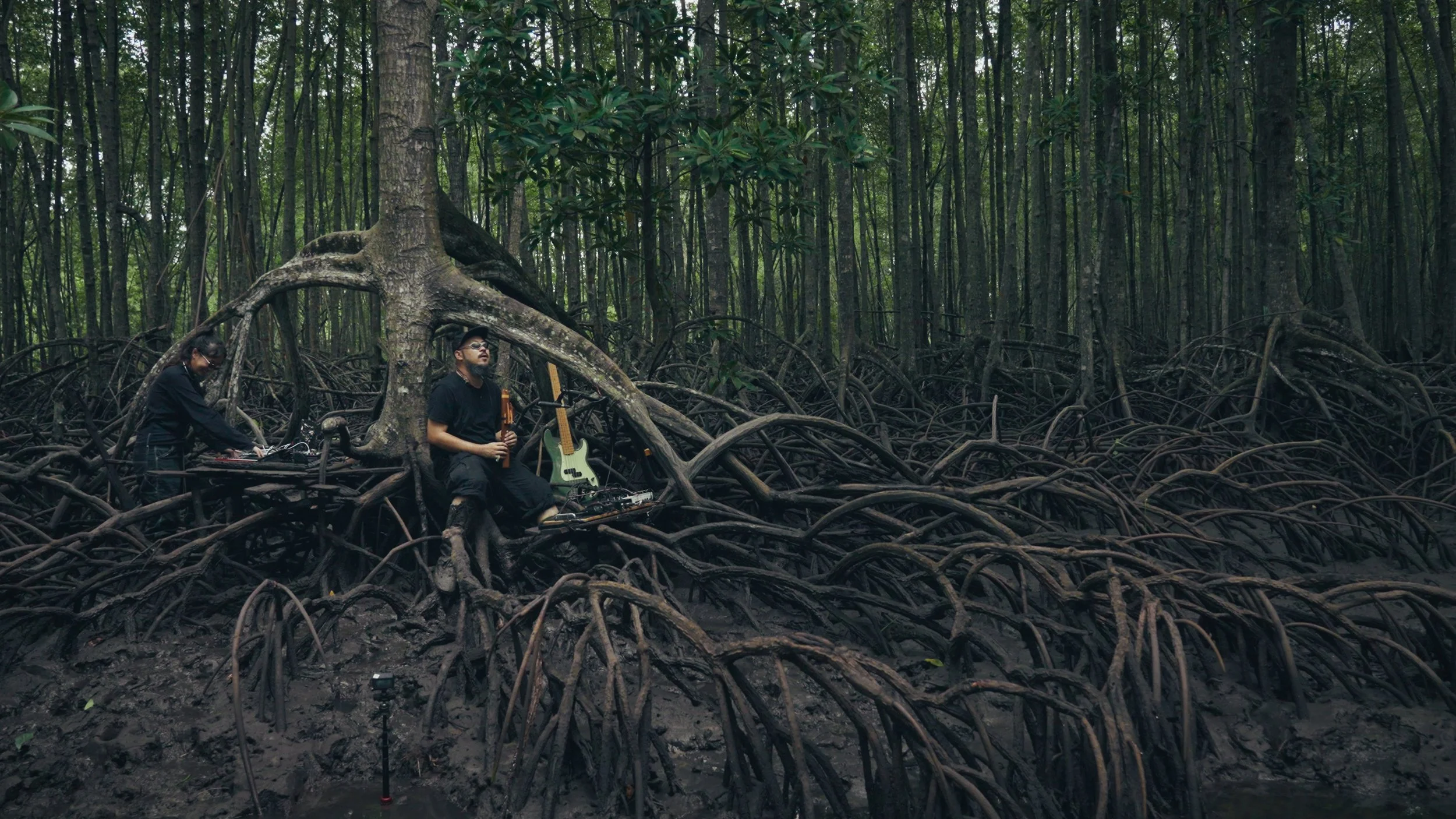

The Film
MANGROOVE is a series of project co-founded by BioReverb and NOTEP, collaborated with 30x30 Coalition Thailand, and supported by neo-baannok. In the film, NOTEP performs a continuous live session inside the mangrove forest connected directly to the leaves of the mangrove, which translates the tree's electrical signals into sound in real time.
Art by SXO296
The film moves through the mangrove ecosystem — its biodiversity, its beauty, the coastal communities who depend on it, and the threats it faces. It has no narration and no explanation. It is the first release from BioReverb, a new creative platform built around the belief that the first step toward protecting something is helping people feel it.
The mangrove forests of Southeast Asia grow where land meets sea — in tidal zones, in the mud, in the places that seem to resist easy description. They are not scenic. They are structural.
A 2011 study in Nature Geoscience measured carbon storage across 25 Indo-Pacific mangrove forests and found an average of 1,023 tonnes of carbon per hectare — three to five times the density of tropical rainforests the same size. (Donato et al., 2011) This carbon sits in deep, waterlogged soils where decomposition barely occurs. It can stay locked there for centuries. When mangroves are cleared, it goes back into the atmosphere.
But carbon is only one part of what a mangrove forest holds. These ecosystems are among the most biodiverse coastal habitats on Earth. Their root systems create a dense architecture where hundreds of species find shelter, food, and breeding ground. Juvenile fish hide between the roots before moving into open water. Fiddler crabs filter sediment and aerate the mud. Mudskippers — fish that breathe air and climb roots — are found almost nowhere else. Migratory birds rest in the canopy. The biodiversity inside a single mangrove forest is specific, layered, and irreplaceable — each species connected to the next in ways that took thousands of years to develop.
These ecosystems are also survival infrastructure for humans. Mangrove roots slow erosion, absorb wave energy, and filter runoff before it reaches the sea. They sustain the livelihoods of tens of millions of people living along tropical coastlines. The communities closest to the forest are often the ones who understand it best — and the ones who lose the most when it disappears.
Background
Southeast Asia has been losing these forests at speed. A 2023 study in Frontiers in Marine Science, using satellite data spanning five decades, found that 44% of mangrove cover across Myanmar, Thailand, and Cambodia had already disappeared by 1996. (Baltezar et al., 2023) Industrial shrimp farming was identified as the primary driver — forests cleared to supply cheap seafood to global markets, while coastal power plants, industrial estates, and port expansions continued the destruction. (Richards & Friess, 2016) The communities living alongside these forests were rarely consulted.
Thailand now faces an additional crisis. Blackchin tilapia (Sarotherodon melanotheron), introduced around 2010, had spread to at least 13 Gulf of Thailand provinces by 2024, outcompeting native species and disrupting the coastal food chains that fishing communities depend on. By that year the scale of damage had reached the Thai parliament and prompted a national eradication campaign that many believe came too late. (Chaianunporn et al., Animals, 2024)
MANGROOVE was filmed on this coastline in May 2026 — inside a forest that is still standing, still alive, still full of creatures going about their lives. We went in to listen. What we found was worth sharing.
 References
Donato, D. C., Kauffman, J. B., Murdiyarso, D., Kurnianto, S., Stidham, M., & Kanninen, M. (2011). Mangroves among the most carbon-rich forests in the tropics. Nature Geoscience, 4(5), 293–297. https://doi.org/10.1038/ngeo1123
Baltezar, P., Murillo-Sandoval, P. J., Cavanaugh, K. C., Doughty, C., Lagomasino, D., Tieng, T., Simard, M., & Fatoyinbo, T. (2023). A regional map of mangrove extent for Myanmar, Thailand, and Cambodia shows losses of 44% by 1996. Frontiers in Marine Science, 10, 1127720. https://doi.org/10.3389/fmars.2023.1127720
Richards, D. R., & Friess, D. A. (2016). Rates and drivers of mangrove deforestation in Southeast Asia, 2000–2012. Proceedings of the National Academy of Sciences, 113(2), 344–349. https://doi.org/10.1073/pnas.1510272113
Chaianunporn, T., Panthum, T., Singchat, W., Chaianunporn, K., Suksavate, W., Chaiyes, A., & Srikulnath, K. (2024). Sustainable ecosystem management strategies for tackling the invasion of blackchin tilapia (Sarotherodon melanotheron) in Thailand: Guidelines and considerations. Animals, 14(22), 3292. https://doi.org/10.3390/ani14223292